Corals and coral reefs host great biological diversity, they are early indicators of environmental change, and they are increasingly under threat. To showcase the outstanding coral research currently being published in PeerJ we have created a new "PeerJ Spotlight"...
PeerJ partners with WriteLaTex – now known as Overleaf
Offer extended to March 31st 2015 PeerJ is delighted to announce that we have partnered with Overleaf (previously known as writeLaTeX). Anyone signing up to our publishing plans between now and March 31st 2015 will receive a free Overleaf account. With a PeerJ 'Basic'...
New mushroom species in a commercial packet – Author Interview
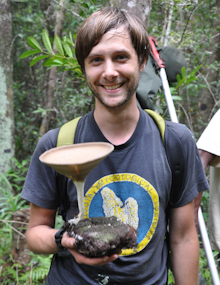
Bryn Dentinger, mycologist at Royal Botanic Gardens, Kew, identified three new species of mushrooms contained within a commercial packet of dried Chinese porcini. Brin and his colleague Laura Suz first reported the discovery in PeerJ PrePrints a few weeks ago, and...
Max Planck Authors Can Now Publish For Free In PeerJ
PeerJ is pleased to announce that the Max Planck Society has signed a publishing plan deal with PeerJ, which entitles any Max Planck author to publish their research in PeerJ at no cost to themselves. With this announcement, thousands of authors in over 80 Max Planck...
Invasion of Asian camel crickets in North American houses – Author Interview
Mary Jane Epps - postdoctoral researcher in the Dunn Lab – explores the ecology of insect communities associated with human homes. She is the lead author of “Too big to be noticed: Cryptic invasion of Asian camel crickets in North American houses”,...
Insect fossils in the Late Jurassic lagoon of France – Interview with an Author
During the course of two field expeditions in 2012 and 2013, French researchers working with the help of two active teams of amateur scientists (Société des Naturalistes et Archéologues de l’Ain and the Group ‘Sympetrum Recherche et...
Author Interview with Alex Clark
Two weeks ago, we published “Fast and accurate semantic annotation of bioassays exploiting a hybrid of machine learning and user confirmation”. In this study, Alex Clark and his colleagues describe a hybrid machine learning / interactive method for marking...
‘I study how crabs sniff’ – Author Interview
Yesterday we published the work of Lindsay Waldrop and her colleagues in which they modeled how the performance of the hermit crab's antennae might change as they both grow and transition from water to air. We invited Lindsay to comment on her research and her...
DNA sequencing in the middle of the Pacific Ocean – Video
A group of researchers including scientists at San Diego State University overcame equipment failure, space constraints and shark-infested waters to do real-time DNA sequencing in a remote field location. Check out this video to find out how they did it! Today we...
DNA sequencing in the middle of the Pacific Ocean – Author Interview
During the 2013 Southern Line Islands Research Expedition, a group of researchers brought a DNA sequencer on a ship in the central Pacific to do remote sequencing in real time. The most surprising thing is that it actually worked! Computer scientists and biologists...