

Nymphanthus belliflorus (Phyllanthaceae), a new species from Thailand
- Published
- Accepted
- Received
- Academic Editor
- Carlos Santamaria
- Subject Areas
- Biodiversity, Plant Science, Taxonomy
- Keywords
- Eriococcus, Morphology, Phyllantheae, Phyllanthus, Taxonomy, Section Nymphanthus
- Copyright
- © 2026 Sukkharom et al.
- Licence
- This is an open access article distributed under the terms of the Creative Commons Attribution License, which permits unrestricted use, distribution, reproduction and adaptation in any medium and for any purpose provided that it is properly attributed. For attribution, the original author(s), title, publication source (PeerJ) and either DOI or URL of the article must be cited.
- Cite this article
- 2026. Nymphanthus belliflorus (Phyllanthaceae), a new species from Thailand. PeerJ 14:e20559 https://doi.org/10.7717/peerj.20559
Abstract
Nymphanthus belliflorus, a newly described species from the northeastern part of Thailand, is the most similar to N. chantaranothaii, N. glaucescens and N. huamotensis in having staminate flowers with four sepals bearing long-fimbriate margins and the pistillate flowers composed of 5–6 sepals with long-fimbriate margins. However, it is distinguished by its swollen stem base, young branchlets that are glabrous, disc glands of staminate flowers that are obdeltoid and yellow-reddish in color, long pedicel of pistillate flowers (3.2–4.8 cm long) and fruits (3.5–5.5 cm long). The description, distribution, ecological information and provisional conservation status are provided.
Introduction
Nymphanthus Lour. (Phyllanthaceae) was first described in Flora Cochinchinensis (de Loureiro, 1790) and later treated as a section within Phyllanthus L. (Müller, 1866). However, morphological and molecular evidence has shown the wide phenotypic variability and paraphyly of Phyllanthus (Hoffmann, Kathriarachchi & Wurdack, 2006; Kathriarachchi et al., 2006; Pruesapan et al., 2012; van Welzen et al., 2014; Bouman et al., 2018). In response, Bouman et al. (2021, 2022) proposed a revised classification of tribe Phyllantheae, resurrecting Nymphanthus as a distinct genus supported by both molecular and morphological data.
Nymphanthus comprises 86 species that are distributed in mainland Asia, Malesia and Australia. The genus can be characterized by four sepals, four free disc glands alternate with sepals, two or four stamens in a staminate flowers and 5–6 sepals, shallowly cupuliform to urceolate or five to rarely six free disc glands, three pistils with bifid or entire stigma in a pistillate flowers (Bouman et al., 2022). Moreover, another distinct characteristic is pollen morphology, which is spheroidal to ellipsoidal shape, pantoporate and reticulate ornamentation type with granules in the lumen (Webster & Carpenter, 2008; Chen et al., 2009). Bouman et al. (2022) divided the genus into section Nymphanthus characterized by its pedicellate flowers, 3-locular ovaries, and bifid stigmas, and section Scepasma (Blume) R.W.Bouman that has sessile or subsessile flowers, (4–) 5–8-locular ovaries, and usually entire stigmas.
In Thailand, eight species of Nymphanthus were reported in Flora of Thailand (previously treated under Phyllanthus) (Chantaranothai, 2007) and two additional species were reported in the country under Phyllanthus as P. chantaranothaii Pornp., J.Parn. & Hodk. and P. huamotensis Pornp., Chantar. & J.Parn. (Pornpongrungrueng et al., 2019). However, with the formal resurrection of Nymphanthus as a distinct genus, these two species were transferred to this genus as N. chantaranothaii (Pornp., J.Parn. & Hodk.) R.W.Bouman and N. huamotensis (Pornp., Chantar. & J.Parn.) R.W.Bouman, respectively (Bouman et al., 2022).
Recently, an uncertain Nymphanthus species was found in the ecotone between mixed deciduous and dry dipterocarp forest on sandstone mountains in Phu Mai Ruak (Mueang district, Sakon Nakhon province) and Phu Wiang National Park (Wiang Kao district, Khon Kaen province) in the northeastern part of Thailand. This plant is most similar to N. chantaranothaii, N. glaucescens (Miq.) R.W.Bouman and N. huamotensis. The taxonomic status of this plant needs to be investigated. Therefore, this study aims to investigate and compare the gross morphology of this unknown Nymphanthus taxon and other similar species to clarify taxonomic status of this newly discovered taxon.
Materials and Methods
The plant samples were collected from Phu Mai Ruak, Sakon Nakhon province in the northeast of Thailand. The morphological characteristics were studied using a stereo microscope. The measurements were taken from dried specimens and compared to the herbarium specimens of similar species kept in various herbaria such as Bangkok Herbarium (BK), Bangkok Forest Herbarium (BKF), Khon Kaen University Herbarium (KKU) and Queen Sirikit Botanic Garden Herbarium (QBG) (herbarium acronym according to Thiers, 2025). This study followed the standard procedures for plant taxonomic research as outlined by Henderson (2005). Moreover, taxonomic literature of the plant from Thailand (Chantaranothai, 2007; Kantachot & Chantaranothai, 2013; Pornpongrungrueng et al., 2017; Pornpongrungrueng et al., 2019) and neighboring countries; China (Li & Gilbert, 2008; Yao et al., 2022), India (Balakrishnan & Chakrabarty, 2007; Chakrabarty & Balakrishnan, 2018), Java (Backer & Bakhuizen van den Brink, 1963), Malaysia (Ridley, 1924; Whitmore, 1973), Myanmar (Kress et al., 2003) and Vietnam (Nguyen, 2007) were investigated.
For seed morphology, mature fruits were air-dried and kept in silica gel. The seed morphological characters were studied following the methods described by Salmaki et al. (2011). Seed outlines were studied and photographed under a Nikon SMZ25 stereo microscope, and the seed coat ornamentation was investigated under LEO 1450VP scanning electron microscope (SEM). Terminology of seed morphology was based on Bojnanský & Fargašová (2007). Due to the lack of seed samples for N. glaucescens, thus the fruit and seed characters for this species were taken from Chantaranothai (2007).
The provisional conservation status was assessed following IUCN Red List categories and criteria (IUCN Standards and Petitions Committee, 2022).
The electronic version of this article in Portable Document Format (PDF) will represent a published work according to the International Code of Nomenclature for algae, fungi, and plants (ICN), and hence the new names contained in the electronic version are effectively published under that Code from the electronic edition alone. In addition, new names contained in this work which have been issued with identifiers by IPNI will eventually be made available to the Global Names Index. The IPNI LSIDs can be resolved and the associated information viewed through any standard web browser by appending the LSID contained in this publication to the prefix “http://ipni.org/”. The online version of this work is archived and available from the following digital repositories: PeerJ, PubMed Central SCIE, and CLOCKSS.
Results
Taxonomic treatment
Nymphanthus belliflorus P. Sukkharom, Chantar. & Pornp., sp. nov. (Figs. 1–3)
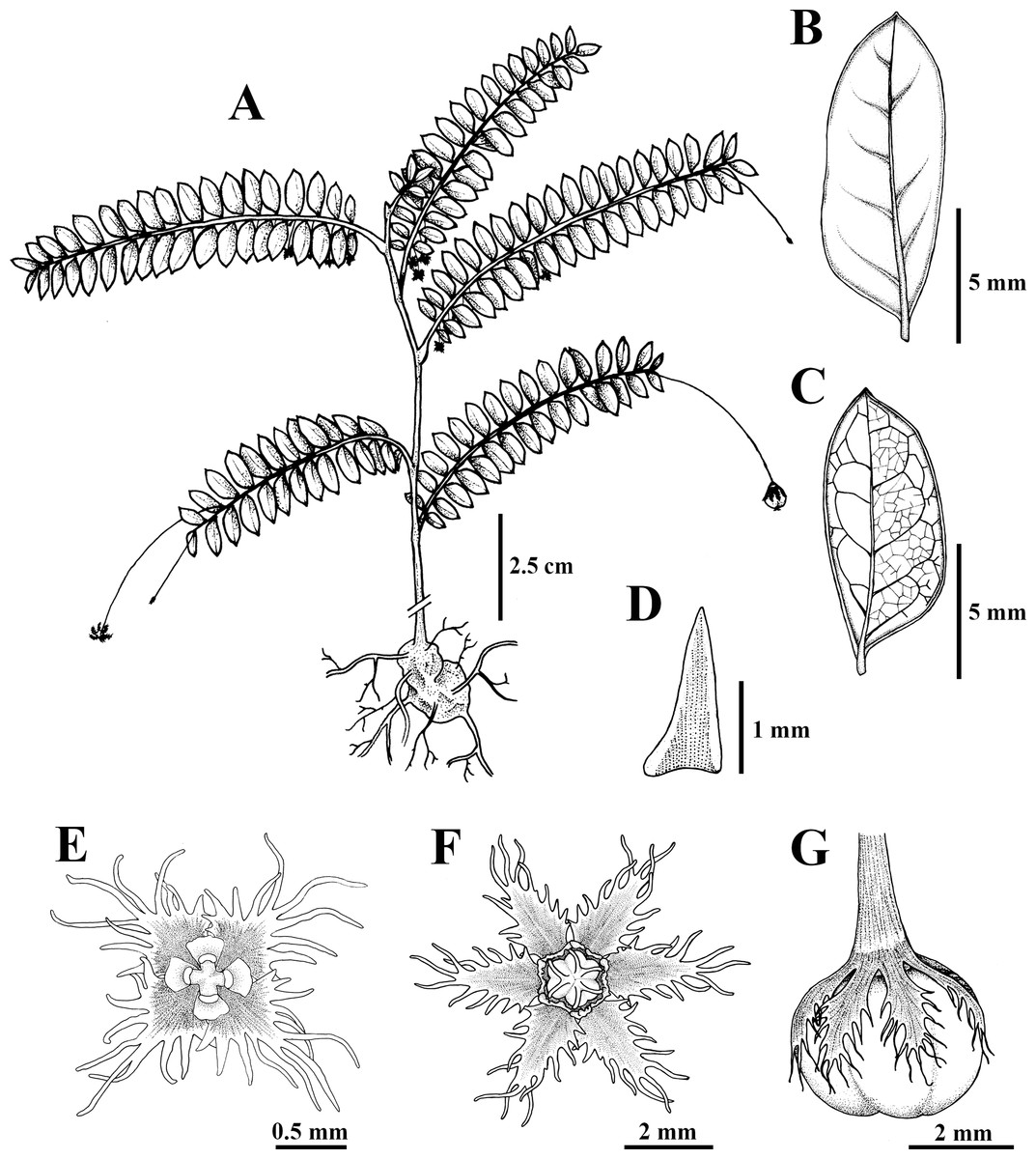
Figure 1: Nymphanthus belliflorus P. Sukkharom, Chantar. & Pornp., sp. nov.
(A) Habit. (B) Leaf (adaxial side). (C) Leaf (abaxial side). (D) Stipule. (E) Staminate flower. (F) Pistillate flower. (G) Mature capsule. Figure drawn by Piya Sukkharom.
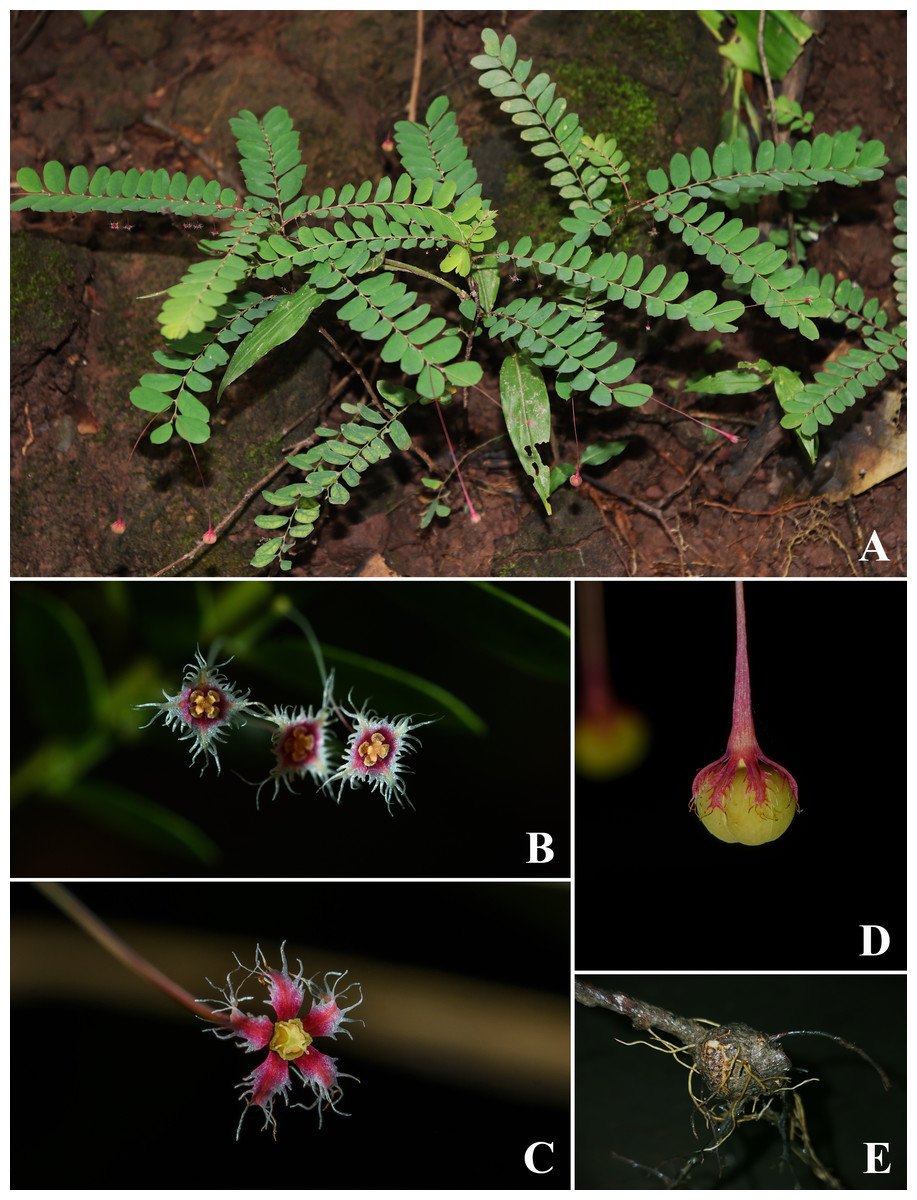
Figure 2: Nymphanthus belliflorus.
(A) Habit. (B) Staminate flowers. (C) Pistillate flower. (D) Mature capsule. (E) Swollen stem base. (A) & (E) photos by Piya Sukkharom, (B–D) photos by Silakan Khunnok.
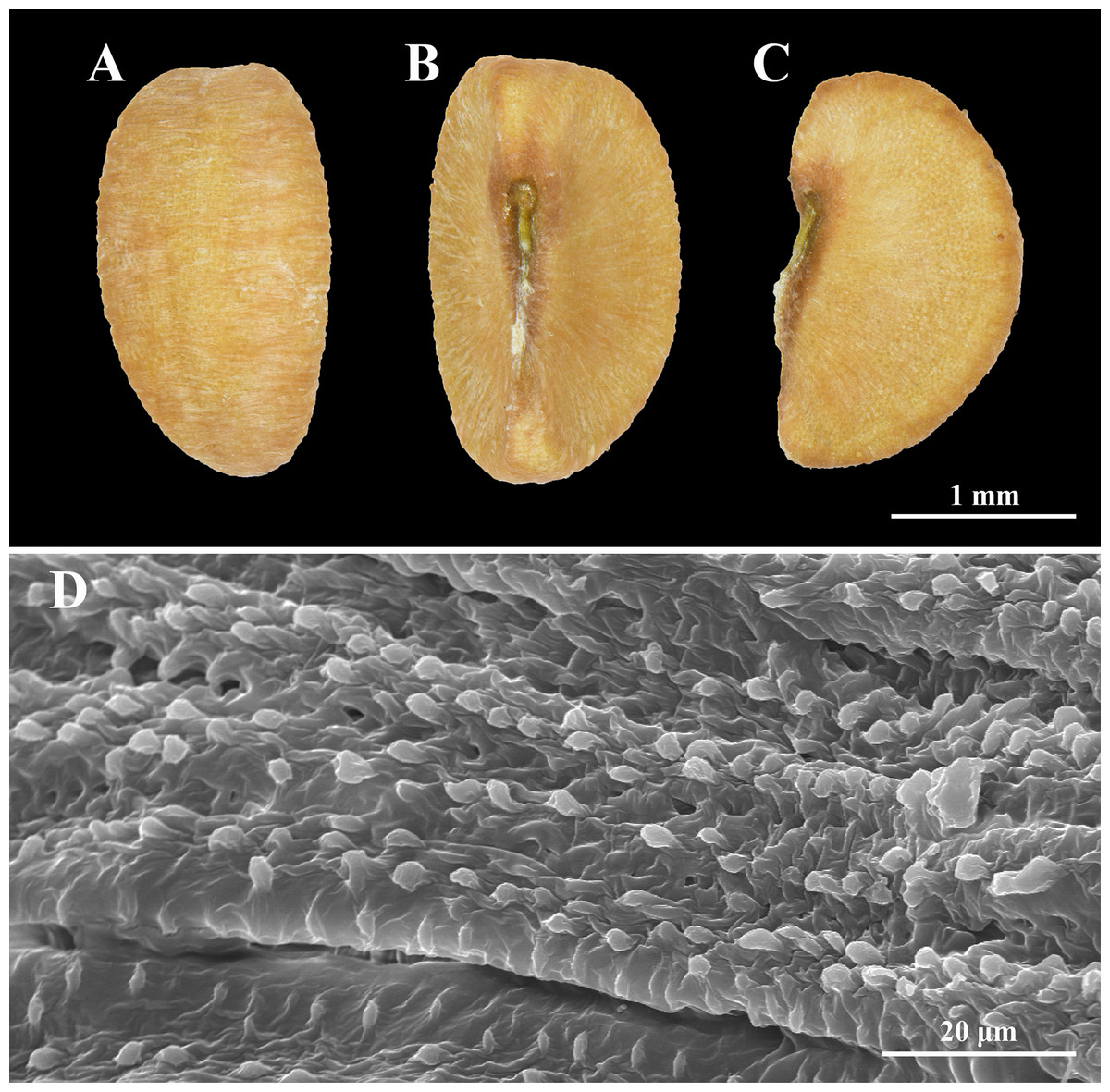
Figure 3: Seed morphology of Nymphanthus belliflorus.
(A) Dorsal view. (B) Ventral view. (C) Lateral view. (D) Transversely granular striate ornamentation.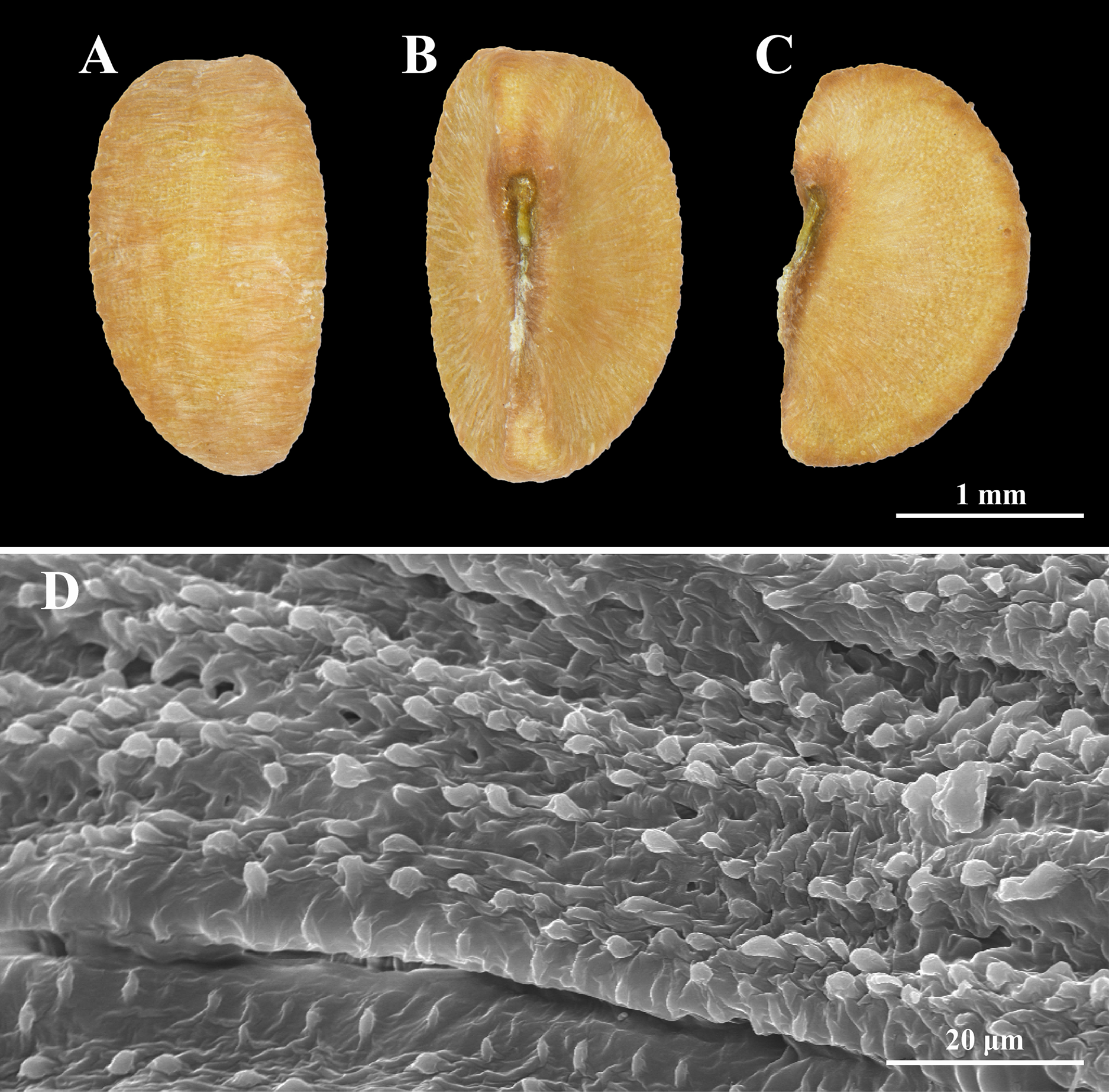
Type. THAILAND. Sakon Nakhon, Mueang District, Huai Yang Subdistrict, Phu Mai Ruak, 17°5.175′N, 104°1.708′E; alt. 242 m; 30 September 2023, P. Sukkharom & P. Pornpongrungrueng 64 (holotype KKU!; isotypes BKF!, QBG!).
Diagnosis. Nymphanthus belliflorus is distinguished from other species of Nymphanthus by a combination of swollen stem base, long-fimbriate sepal margins in both staminate and pistillate flowers, obdeltoid, yellow to reddish disc glands in staminate flowers, and long pedicels in pistillate flowers and fruits (3.2–4.8 cm long and 3.5–5.5 cm long, respectively).
Description. Undershrubs, 20–60 cm high; branchlets terete, greenish or reddish, glabrous; stem base swollen. Stipules lanceolate-subulate, 0.6–2 by 0.2–0.8 mm, glabrous. Leaves alternate; petiole 0.2–0.5 mm long, glabrous to papillose; laminar ovate, obovate to oblong, 0.2–1.7 by 0.2–0.8 cm, membranous, base oblique, margin entire, marginate, apex mucronate or acute; lateral veins in 2–5 pairs. Flowers unisexual; staminate flowers 1–3 in axillary fascicles along the lower part of the branchlets; pistillate flowers solitary in distal axils. Bracts subulate, 0.5–1 by 0.1–0.2 mm, glabrous. Staminate flowers: pedicel 6–8 mm long, reddish, glabrous; sepals 4, red with white margin, rhombic-ovate, 1.3–1.6 by ca. 1 mm, margin long fimbriate; disc gland 4, yellow-reddish at the lower part, free, obdeltoid; column ca. 0.1 mm long; anthers 0.1–0.2 mm long, transversely dehiscent. Pistillate flowers: pedicel (2–)3.2–4.8 cm long, reddish, glabrous; sepals (5–)6, red with white margin, narrowly lanceolate, 2–2.8 by ca. 1 mm, margin long fimbriate; disc gland annular, 6-lobed, yellowish, surface undulate or tuberculate; ovary superior, ca. 1 mm diam., 3-locular, ovule 2 per locule, glabrous to slightly undulate; styles 3, free, ca. 0.1 mm long; stigmas almost entirely bifid, ca. 0.2 mm, glabrous. Fruits capsular, smooth, 3.3–4.8 mm diam., greenish or reddish; pedicel 3.5–5.5 cm long. Seeds trigonous, pale brown, 2.3–2.5 by 1.3–1.4 mm, surface transversely granular striate.
Etymology. The specific epithet refers to the beautiful flowers of this species.
Vernacular name. Wan thorani san lek (proposed here).
Distribution. Khon Kaen and Sakon Nakhon Provinces in the northeast of Thailand.
Ecology. Nymphanthus belliflorus grows on sandy soil with organic matter found in the ecotone between mixed deciduous and dry dipterocarp forest, at 240–285 m elevation.
Phenology. Flowering and fruiting in June–October.
Provisional conservation assessment. Nymphanthus belliflorus is currently known from only two populations of less than 100 km2 in the northeast of Thailand and the current investigation revealed fewer than 250 mature individuals, it is considered Critically Endangered (CR) according to criteria B1a (i, ii, v), B2a (i, ii, v), and C2a (ii) of the IUCN Red List (IUCN Standards and Petitions Committee, 2022). Nevertheless, there should be further studies to confirm conservation status of this species.
Additional specimens examined. THAILAND. Khon Kaen: Wiang Kao District, Phu Wiang National Park, 6 July 2006, P. Chantaranothai 23/2006 (KKU!).
Discussion
The newly discovered taxon, Nymphanthus belliflorus, is assigned to Nymphanthus section Nymphanthus based on its pedicellate flowers, 3-locular ovaries and bifid stigmas. It closely resembles to N. chantaranothaii, N. glaucescens and N. huamotensis in having staminate flowers with four sepals bearing long-fimbriate margins and the pistillate flowers composed of 5–6 sepals with long-fimbriate margins. However, it can be distinguished by its swollen stem base (not swollen in other species), young branchlets that are glabrous (puberulous in other species), disc glands of staminate flowers are obdeltoid and yellow-reddish (reniform and red in other species), pistillate flowers with long pedicel, 3.2–4.8 cm long (1.2–1.4 cm long in N. chantaranothaii, 1.7–2.5 cm in N. glaucescens and 1.1–1.3 cm in N. huamotensis), fruiting pedicel with 3.5–5.5 cm long (1.2–1.5 cm long in N. chantaranothaii, 1.5–2.2 cm in N. glaucescens and 1.3–1.4 cm in N. huamotensis), fruit diameter ranges from 3.3–4.8 mm (2.5–4 mm in N. chantaranothaii, ca. 2.5 mm in N. glaucescens and 2.5–3 mm in N. huamotensis) and seed length ranges 2.3–2.5 mm (1.7–2.0 mm in N. chantaranothaii, 2–3 mm in N. glaucescens and 1.5–1.6 mm in N. huamotensis) (Table 1).
Key to the species of Thai Nymphanthus
(modified from Flora of Thailand (Chantaranothai, 2007) with additional diagnostic characters incorporated from the present study)
1a. Margin of sepals entire 2
1b. Margin of sepals fimbriate 3
2a. Leaf blades obliquely ovate, 5–12 by 2.5–4 cm N. longifolius
2b. Leaf blades oblong, 0.3–0.5 by 0.05–0.1 cm N. taxodiifolius
3a. Leaves puberulous on upper or both surfaces 4
3b. Leaves glabrous 5
4a. Leaf blade oblong or obovate, 1–2.1 by 0.5–0.8 cm, puberulous on upper surface. Pistillate flowers solitary in leaf-axils along upper half of the branchlets N. chantaranothaii
4b. Leaf blade obliquely ovate, 2.9–3.7 by 1.5–2.1 cm, puberulous on both surfaces. Pistillate flowers solitary in bare racemes in distal axils, sometimes in leaf-axils N. tetrandrus
5a. Branchlets glabrous 6
5b. Branchlets pubescent, puberulous or furfuraceous 8
6a. Leaves more than 5 cm long. Capsules inflated N. elegans
6b. Leaves less than 5 cm long. Capsules not inflated 7
7a. Stem base swollen. Margin of sepals long fimbriate. Pistillate flower pedicels at least 2 cm long Nymphanthus belliflorus P. Sukkharom, Chantar. & Pornp., sp.nov.
7b. Stem base not swollen. Margin of sepals short fimbriate. Pistillate flower pedicels up to 2 cm long N. sootepensis
8a. Ovary glabrous N. glaucescens
8b. Ovary papillose-puberulous or villous 9
9a. Undershrubs to 30 cm high. Leaf blades broadly ovate, obovate, rounded, broadly elliptic or ovate-oblong, venation reddish N. huamotensis
9b. Shrubs to 3 m high. Leaf blades oblong, oblong-lanceolate or lanceolate, venation not reddish 10
10a. Leaf blades lanceolate, 4–7.5 by 2–2.5 cm, petioles 2–3 mm long. Sepals of pistillate flowers 3–5 by 2–3 mm N. gracilis
10b. Leaf blades oblong to oblong-lanceolate, 1.3–2.6 by 0.4–0.9 cm, petioles 0.5–1 mm long. Sepals of pistillate flowers 2.2–3 by 1.2–1.8 mm N. pulchroides
| Characteristics | N. belliflorus | N. chantaranothaii | N. glaucescens | N. huamotensis |
|---|---|---|---|---|
| Habit | Undershrub, up to 0.6 m | Shrub, up to 1 m | Shrub, up to 1.2 m | Undershrub, up to 0.3 m |
| Stem base | Swollen | not swollen | not swollen | not swollen |
| Young branchlet | Glabrous | Puberulous | Puberulous | Puberulous |
| Leaf | ||||
| Shape | Ovate, obovate, oblong | Oblong, obovate | Ovate, obovate, elliptic | Broadly ovate, rounded |
| Width | 0.2–0.8 cm | 0.6–0.8 cm | 0.6–1.8 cm | 0.2–0.7 cm |
| Length | 0.2–1.7 cm | 1–1.8 cm | 1–3 cm | 10.2–0.8 cm |
| Texture | Membranous | Membranous | Subcoriaceous | Subcoriaceous |
| Staminate flower | ||||
| Sepal | 4, red with long white fimbriate margin, rhombic-ovate | 4, red with long white fimbriate margin, rhombic-ovate | 4–6, red with white long fimbriate, lanceolate | 4, red with long fimbriate margin, rhombic-ovate |
| Disc gland | Yellow with reddish at the lower part, obdeltoid | Red, reniform | Red, reniform | Red, reniform |
| Arrangement | 1–3 flowers in a fascicle, the lower part of the branchlets | 2–3 flowers in a fascicle, the lower part of the branchlets | 2–6 flowers in a fascicle, the lower part of the branchlets | 2–4 flowers in a fascicle, the lower part of the branchlets |
| Pedicel length | 0.6–0.8 cm | 0.6–1.2 cm | 0.8–1.2 cm | 0.7–1 cm |
| Pistillate flower | ||||
| Sepal | (5–)6, red with long fimbriate margin, narrowly lanceolate | 6, red with long white fimbriate margin, narrowly lanceolate | 6, white with red at the lower part and long fimbriate margin, lanceolate | 5 or 6, red with long fimbriate, lanceolate |
| Disc gland | 6, annular, yellowish, surface undulate or tuberculate | 6, free, yellowish, obovate with truncate apex, surface undulate | 5 or 6, annular, yellowish, surface tuberculate | 5 or 6, free, red, obovate with truncate apex, surface undulate |
| Arrangement | Solitary in distal axils | Solitary in the upper part of axils | Solitary in the distal or upper part of axils | Solitary in distal axils |
| Pedicle length | (2–)3.2–4.8 cm | 1.2–1.4 cm | 1.7–2.5 cm | 1.1–1.3 cm |
| Capsule | ||||
| Diameter | 3.3–4.8 mm | 2.5–4 mm | ca. 2.5 mm | 2.5–3 mm |
| Surface | Smooth | Smooth | Smooth | Papillose |
| Pedicel length | 3.5–5.5 cm | 1.2–1.5 cm | 1.5–2.2 cm | 1.3–1.4 cm |
| Seed | ||||
| Width | 1.3–1.4 mm | 1.0–1.4 mm | 0.3–0.5 mm | 1.0–1.2 mm |
| Length | 2.3–2.5 mm | 1.7–2.0 mm | 2–3 mm | 1.5–1.6 mm |
| Length-to-width ratio | 1.78:1 | 1.54:1 | 6.25:1 | 1.41:1 |
| Shape | Trigonous | Trigonous | Trigonous | Trigonous |
| Surface ornamentation | Transversely granular striate | Transversely granular striate | No data | Transversely granular striate |
Conclusions
This study confirmed that Nymphanthus belliflorus is a new species that is supported by the distinct morphological characteristics.