

Contribution of socio-demographic factors in prevalence of soil-transmitted helminth infections among newly arrived laborers in Jeddah, Saudi Arabia
- Published
- Accepted
- Received
- Academic Editor
- Arif Siddiqui
- Subject Areas
- Parasitology, Epidemiology, Global Health, Infectious Diseases
- Keywords
- Prevalence, Soil-transmitted helminths, Jeddah, Saudi Arabia, Socio-demographic, Expatriate laborers, Infection
- Copyright
- © 2024 Wakid and Al-Refai
- Licence
- This is an open access article distributed under the terms of the Creative Commons Attribution License, which permits unrestricted use, distribution, reproduction and adaptation in any medium and for any purpose provided that it is properly attributed. For attribution, the original author(s), title, publication source (PeerJ) and either DOI or URL of the article must be cited.
- Cite this article
- 2024. Contribution of socio-demographic factors in prevalence of soil-transmitted helminth infections among newly arrived laborers in Jeddah, Saudi Arabia. PeerJ 12:e18216 https://doi.org/10.7717/peerj.18216
Abstract
Background
Soil-transmitted diseases are caused by intestinal worms transmitted via various routes into the human body resulting in various clinical manifestations. This study aimed to investigate the socio-demographic factors contributing mainly to the prevalence of soil-transmitted helminths (STHs) among newly arrived laborers in Jeddah, Saudi Arabia.
Methods
A total of 188 stool specimens were collected and examined macroscopically and microscopically using different techniques. In addition, real-time PCR was used as a molecular tool to detect several STHs. The descriptive analysis was used to evaluate demographic data and categorical variables in association with STHs infection.
Results
Of all participants, the mean age was 26.08 ± 2.67 years, including 103 females and 85 males. A total of 86 (45.70%) were illiterate, followed by 60 (31.90%) of participants belonging to elementary level. STHs and other intestinal parasites were detected among 35 newly arrived laborers (18.61%). Nineteen cases (10.11%) were infected with STHs, including 15 cases with one STHs (four A. lumbricoides, four N. americanus, four T. trichiura, two S. stercoralis, one A. duodenale) and four cases with two STHs (two T. trichiura and N. americanus; one S. stercoralis and A. duodenale; one T. trichiura and S. stercoralis). High rates of STHs infection were detected among drivers (11.70%) followed by housemaids (11.20%), but with no significant association to occupation. Higher rates of STHs infection were detected among those used to walk on soil barefoot in their home countries before arriving in Jeddah.
Conclusion
This study found that none of the newly arrived expatriate laborers in Jeddah was aware of STHs. About 10% of them had infection with one or two STHs, mainly among newly arrived laborers from Asian countries. There is a need for awareness programs and regular screening for STHs and other intestinal parasites among newly arrived expatriate laborers.
Introduction
Approximately 50% of the population in tropical and subtropical areas suffer from intestinal parasitic infections associated with helminth and protozoa (Ahmed, 2023). The World Health Organization (WHO) considers infections caused by soil-transmitted helminths (STHs) among the common human diseases and estimates that 1.5 billion people worldwide are infected with at least one or more species of STHs, representing 24% of the world population. These parasites are common in areas with poor sanitation and hygiene, especially in Africa, South America and Asia, where ideal climatic conditions for egg survival and larval development in the environment facilitate transmission (World Health Organization, 2023a).
The main STHs that inhabit the intestine of humans are Ascaris lumbricoides, Trichuris trichiura, Necator americanus, Ancylostoma duodenale and Strongyloides stercoralis (World Health Organization, 2020a; Wakid, 2020a). The first four parasites were given more attention and are considered as a group because they have similar diagnostic procedures and respond to the same medications. N. americanus and A. duodenale are referred together as “hookworms”. Strongyloidiasis is among the most neglected tropical diseases but has recently received increased attention in accordance with WHO 2030 global target (World Health Organization, 2020b).
There is no direct infection from freshly passed stool, or from person-to-person, as the eggs need 2–4 weeks to mature and become infectious. Transmission is mainly through ingestion of mature infective egg in contaminated soil, vegetables, or water (A. lumbricoides, T. trichiura), or via direct penetration of skin by filariform larvae (N. americanus, A. duodenale and S. stercoralis), when walking barefoot on contaminated soil. A. duodenale can also be transmitted by ingestion of filariform larvae (World Health Organization, 2023a; Wakid, 2020a; World Health Organization, 2020c). It is estimated that A. lumbricoides, T. trichiura, hookworms and S. stercoralis infect approximately 1 billion, 800 million, 700 million and 70 million, respectively (Holland et al., 2022; Truscott, Turner & Anderson, 2015; World Health Organization, 2013).
Heavy infection with STHs usually cause a range of health symptoms such as abdominal pain, weakness, diarrhea, dysentery, blood and protein loss, anemia, inflammation, rectal prolapse, physical and cognitive growth retardation, intestinal obstruction, impairment of nutrient intake, digestion and absorption. In case of reduced host immunity, S. stercoralis can cause hyperinfection/dissemination syndrome that is often fatal despite the treatment (World Health Organization, 2023a; World Health Organization, 2023b).
According to WHO, morbidity can be reduced intensively in endemic areas through periodic preventive chemotherapy to people at risk. In addition: health and hygiene education reduce transmission and reinfection by encouraging healthy behaviors and improvement in sanitation, but not always possible in resource-poor settings (World Health Organization, 2023b; World Health Organization, 2021).
Global changes in the human sociocultural spectrum have altered the parasitic relationship of worms with humans (Alum, Rubino & Ijaz, 2010; World Health Organization, 2006). Income or poverty are socio-economic characteristics. Agriculture and fishing (Nobre et al., 2013), the size of the family and number of siblings (Bouwmans et al., 2016), the age of the children (Okpala et al., 2014; Jacobsen et al., 2007), the educational standing of the household (Heidari & Rokni, 2003), and the health monitoring or provision of health education (Fouamno Kamga et al., 2011; Kanoa et al., 2006), all have a role in the parasitic disease’s continuous transmission.
In our previous study in Jeddah, we investigated the prevalence of intestinal parasites, and compared several techniques for the detection of STHs among newly arrived expatriate laborers (Al-Refai & Wakid, 2024). The current study looked at the socio-demographic conditions as a contributing factor in the prevalence of STHs among those laborers.
Materials and Methods
This study was conducted according to the guidelines of the Declaration of Helsinki and approved by The Ethics and Research Committee of the Faculty of Applied Medical Sciences, King Abdulaziz University, (FAMS-EC2018-012), and written informed consent was obtained from each participant.
This cross-sectional study included newly arrived expatriate laborers to Jeddah, during the week prior to specimens’ collection, without any exclusion criteria, and regardless of age, gender and nationality. A total of 188 stool specimens were collected and investigated at parasitology laboratory as previously illustrated in details in the first part of our study (Al-Refai & Wakid, 2024), including macroscopic examination (to detect stool consistency, color, presence of blood, mucus, and any adult worms or gravid segments of tapeworms), direct wet smears (using saline and iodine to examine 1–2 mg of stool), sedimentation formal ether technique (a concentration method to examine 2 g of stool), permanent staining with trichrome (to confirm the morphological features of the intestinal protozoan amoebas and flagellates), modified Kinyoun’s (to detect Cryptosporidium oocyst), rapid immunochromatographic diagnostic tests (specific to detect Giardia lamblia, Cryptosporidium, and Entamoeba histolytica antigens in stool), and real-time PCR using specific primers for STHs (target genes included ITS1 for A. lumbricoides and T. trichiura, ITS2 for A. duodenale and N. americanus, and 18S rRNA for S. stercoralis).
A verbal interview was conducted with each newly arrived participant to fill in a questionnaire form and sign an informed consent form. Some of the laborers were from Arab countries and share authors same language. Most of non-Arab laborers were able to understand English, and for those who do not speak or understand Arabic or English, we asked other workers of the same nationality who speaks English or Arabic to help in translation. Demographic data and other information were collected, including gender, age, marital status, nationality, education level, awareness about STHs, walking on soil barefoot, washing vegetables and fruits before eating, and type of residence in their home countries before arriving to Jeddah.
Data were analyzed by using SPSS (version 25; Armonk, NY, USA). Categorical data were reported as frequency, cross-tabulation and percentage. Statistical significance for the variation in the frequency between groups was determined by the Pearson chi-square χ2 test. Relative risk regression analysis (RR) was performed for each investigated factor. The p-value was calculated at a significance level of p < 0.05.
Results
One hundred and eighty-eight newly arrived laborers participated in this study; out of them 103 (54.8%) were females, 85 (45.2%) were males, and 55.3% were married. The mean age was 26.08 ± 2.67 years. Among those, 86 (45.7%) were illiterate, followed by 60 (31.9%) with elementary education. Most of the participants were housemaids (52.1), drivers (32%), and shepherds (7.4%). The majority of the newly arrived laborers (65%), were from six Asian countries (Philippine, India, Bangladesh, Indonesia, Cambodia, Sri Lanka), while the remaining 35% were from six Africans countries (Sudan, Morocco, Egyptian, Nigeria, Ghana, Somalia) (Table 1).
| Variable | No. (%) |
|---|---|
| Gender | |
| Female | 103 (54.79%) |
| Male | 85 (45.21%) |
| Mean age (years) | 26.08 ± 2.67 |
| Education level | |
| Illiterate | 86 (45.74%) |
| Elementary | 60 (31.91%) |
| Intermediate | 38 (20.21%) |
| Secondary | 4 (2.13%) |
| Occupation | |
| Housemaid | 98 (52.13%) |
| Driver | 60 (31.91%) |
| Shepherd | 14 (7.45%) |
| General | 6 (3.19%) |
| Housekeeper | 4 (2.13%) |
| Babysitter | 1 (0.53%) |
| Cook | 1 (0.53%) |
| Cleaner | 1 (0.53%) |
| Nationality | |
| Pilipino | 56 (29.79%) |
| Indian | 45 (23.94%) |
| Sudanese | 28 (14.89%) |
| Moroccan | 22 (11.70%) |
| Bangladeshi | 13 (6.91%) |
| Egyptian | 10 (5.32%) |
| Indonesian | 7 (3.72%) |
| Nigerian | 3 (1.60%) |
| Cambodian | 1 (0.53%) |
| Ghanaian | 1 (0.53%) |
| Somalian | 1 (0.53%) |
| Sri Lankan | 1 (0.53%) |
| Marital status | |
| Married | 104 (55.32%) |
| Not married | 84 (44.68%) |
Out of the 35 infected cases, 26 (74%) revealed single infections, eight (23%) with double infections, and only one (3%) triple infection of different intestinal parasites. Among those infected cases, 19 were infected with STHs (seven from Philippine, five from India, two from Morrocco, one from Indonesia, one from Bangladesh, one from Sudan, one from Egypt, and one from Nigeria) (Table 2, Fig. 1).
There were no significant differences regarding infection with STHs and gender, age, marital status, education level, and residence (p > 0.05). However, higher rates of STHs infection were detected among females, unmarried of less than 26 years old, illiterate and resident in rural areas (Table 3). Similarly, there was no significant variation of infection with STHs and the occupation and the geographic area of the newly arrived laborers (p > 0.05), but higher infection rates were detected among Asians and housemaids (Table 3).
| Type of infection | Detected parasites | No. positive cases | Nationality | Gender | Occupation | Education level |
|---|---|---|---|---|---|---|
| Single (26) | A. duodenale1,2 | 1 | Pilipino | Female | Housemaid | Intermediate |
| A. lumbricoides1,2 | 4 | Indian | Male | Driver | Intermediate | |
| Nigerian | Male | Housekeeper | Elementary | |||
| Pilipino | Female | Housemaid | Illiterate | |||
| Sudanese | Male | Driver | Elementary | |||
| B. hominis1 | 1 | Pilipino | Female | Housemaid | Elementary | |
| E. coli1 | 7 | Somalian | Female | Housemaid | Elementary | |
| Sri Lankan | Male | Driver | Illiterate | |||
| Pilipino | Female | Housemaid | Illiterate | |||
| Bangladeshi | Male | Worker | Illiterate | |||
| Indian | Male | Driver | Elementary | |||
| Pilipino | Female | Housemaid | Elementary | |||
| Moroccan | Female | Housemaid | Illiterate | |||
| E. histolytica1 | 1 | Indian | Male | Driver | Intermediate | |
| E. nana1 | 1 | Indian | Male | Driver | Illiterate | |
| G. lamblia1 | 2 | Pilipino | Female | Housemaid | Illiterate | |
| Pilipino | Female | Housemaid | Intermediate | |||
| H. heterophyes1 | 1 | Indian | Female | Housemaid | Illiterate | |
| H. nana1 | 1 | Sudanese | Female | Babysitter | Secondary | |
| N. americanus1,2 | 2 | Indonesian | Male | Driver | Illiterate | |
| Bangladeshi | Female | Housemaid | Illiterate | |||
| S. stercoralis1,2 | 2 | Egyptian | Male | Driver | Intermediate | |
| Pilipino | Female | Housemaid | Illiterate | |||
| T. trichiura1,2 | 3 | Pilipino | Female | Housemaid | Illiterate | |
| Moroccan | Female | Housemaid | Illiterate | |||
| Indian | Male | Driver | Illiterate | |||
| Double (8) | N. americanus1,2 +B. hominis1 | 1 | Indian | Male | Driver | Illiterate |
| N. americanus1,2 + E. histolytica1 | 1 | Pilipino | Female | Housemaid | Illiterate | |
| E. coli1 + E. histolytica1 | 1 | Pilipino | Female | Housemaid | Illiterate | |
| E. histolytica1+ B. hominis1 | 1 | Moroccan | Female | Housemaid | Elementary | |
| S. stercoralis1,2 + A. duodenale1,2 | 1 | Moroccan | Female | Housemaid | Illiterate | |
| T. trichiura1,2 +N. americanus1,2 | 2 | Indian | Female | Housemaid | Illiterate | |
| Pilipino | Female | Housemaid | Intermediate | |||
| T. trichiura1,2 + S. stercoralis 2 | 1 | Pilipino | Female | Housemaid | Intermediate | |
| Triple (1) | T. trichiura1,2 + E. coli1 + I. bütschlii1 | 1 | Indian | Male | Driver | Illiterate |
As shown in Table 3, none of the investigated newly arrived laborers is aware about the mode of infection of STHs, and there was a significant correlation between the infection among newly arrived laborers that used to walk on soil barefoot in their home countries before arriving to Jeddah.
Discussion
As we mentioned in our previous work, to the best of our knowledge, this study is the first in Jeddah and Saudi Arabia to estimate STHs prevalence among newly arrived expatriate laborers using macroscopic and several microscopic examinations, in addition to real-time PCR for detection and speciation of STHs (Al-Refai & Wakid, 2024). Quantitative PCR is highly sensitive and has rapid utility in detecting STHs (Azzopardi et al., 2021). In our study, the prevalence of STH was 10.11% among 188 newly arrived laborers from different Asian and African countries. Previous studies conducted in Saudi Arabia reported various prevalence values of STHs in Baharah, Makkah, Al-Madina, Al-Baha and Al-Khobar (Wakid, 2020b; Ahmed et al., 2015; Mohammad & Koshak, 2011; Abahussain, 2005). All these previous studies agree with our findings that the participants’ age range between 20–35 years, most of them were females from Asian countries. The predominant female participants were expected because of the large numbers working as housemaids.
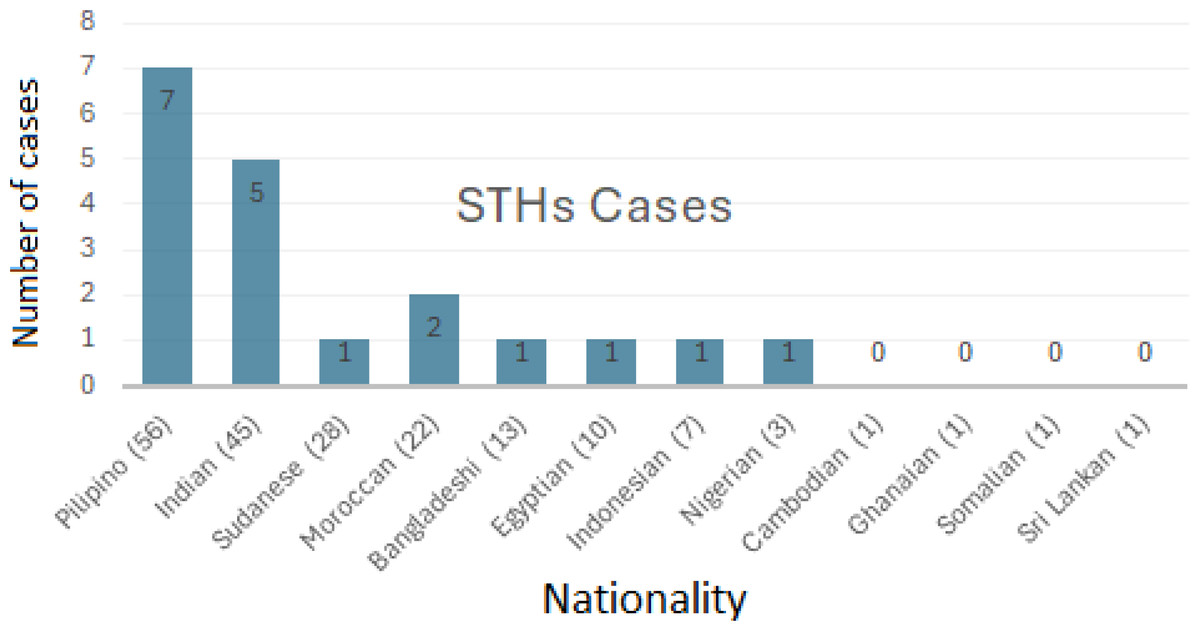
Figure 1: Infection with STHs detected among participants belonging to different nationalities.
The total number and the infected cases with STHs among each nationality of the newly arrived expatriate laborers.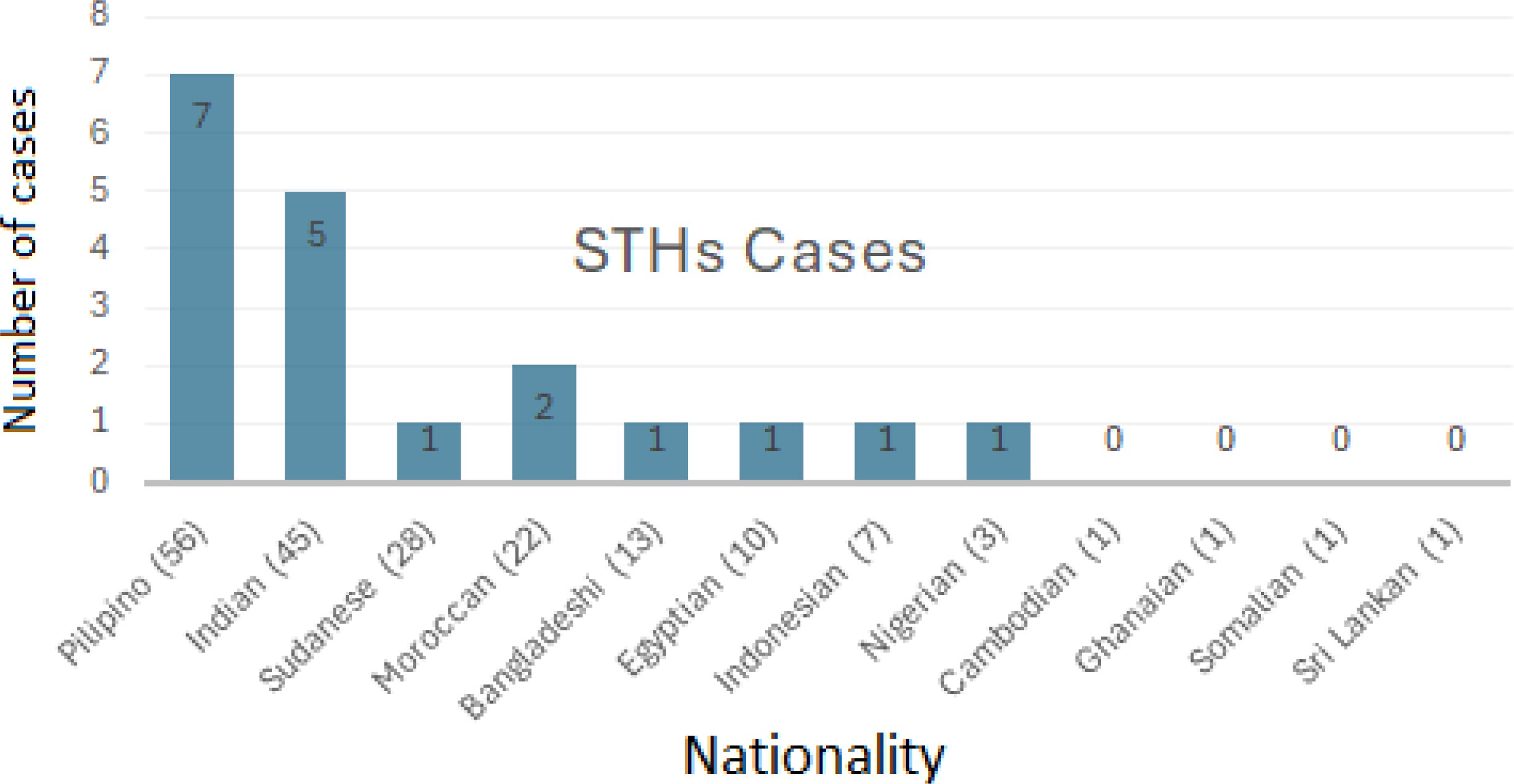
Among the detected STHs, 15 cases were infected with one STHs including A. lumbricoides, N. americanus, T. trichiura, four cases each, two cases S. stercoralis and one case A. duodenale. On the other hand, four cases were infected with two STHs (2 cases with T. trichiura and N. americanus; 1 case with S. stercoralis and A. duodenale; 1 case with T. trichiura and S. stercoralis). In the current study, there was no significant variation in the rate of infection with the STHs and sample consistency (p > 0.05), however higher rates of STHs infection were detected in soft/loose samples. Although there was no significant association between STHs infection and education level (p > 0.05), higher infection rates were detected among illiterates (14%) compared to other educational levels. We believe illiterate communities lack of adequate knowledge of proper hygiene and sanitation practices (Sah et al., 2015; Rayamajhi et al., 2014).
| Variables | Categories (N) | Positive STHsn (%) | Negative STHsn (%) | RR (95% CI) | P-value |
|---|---|---|---|---|---|
| Gender | Male (85) | 8 (9.41) | 77 (90.59) | 1.135 (0.478–2.693) | 0.777 |
| Female (103) | 11 (10.68) | 92 (89.32) | Ref | ||
| Marital status | Married (104) | 7 (6.73) | 97 (93.27) | 0.471 (0.194–1.144) | 0.096 |
| Not married (84) | 12 (14.29) | 72 (85.71) | Ref | ||
| Geographic region | Asian (123) | 14 (11.38) | 109 (88.62) | 0.676 (0.256–1.793) | 0.431 |
| African (65) | 5 (7.69) | 60 (92.31) | Ref | ||
| Age group(years) | 20–25 (82) | 12 (14.63) | 70 (85.37) | Ref | |
| 26–35 (106) | 7 (6.60) | 99 (93.40) | 2.216 (0.913–5.377) | 0.078 | |
| Education level | Illiterate (86) | 12 (13.95) | 74 (86.05) | 0.853 (0.322–2.264) | 0.749 |
| Elementary (60) | 2 (3.33) | 58 (96.67) | 3.751 (0.727–17.544) | 0.117 | |
| Intermediate/Secondary (42) | 5 (11.9) | 37 (88.1) | Ref | ||
| Awareness about STHs | Aware (0) | 0 (0) | 0 (0) | - | - |
| Not aware (188) | 19 (10.11) | 169 (89.89) | |||
| Walk on soil barefoot | Yes (69) | 12 (17.39) | 57 (82.61) | 0.338 (0.140–0.819) | 0.016 |
| No (119) | 7 (5.88) | 112 (94.12) | Ref | ||
| Wash vegetables/ fruits before eating | Yes (66) | 6 (9.09) | 60 (90.91) | Ref | |
| No (122) | 13 (10.66) | 109 (89.34) | 0.853 (0.340–2.140) | 0.729 | |
| Residence | Rural (128) | 11 (8.59) | 117 (91.41) | 1.552 (0.658–3.658) | 0.315 |
| Urban (60) | 8 (13.33) | 52 (86.67) | Ref | ||
| Occupation | Housemaid (98) | 11 (11.22) | 87 (88.78) | Ref | |
| Driver (60) | 7 (11.67) | 53 (88.33) | 0.962 (0.395–2.346) | 0.932 | |
| Other duties (30) | 1 (3.33) | 29 (96.67) | 3.367 (0.453–25.028) | 0.235 | |
| Stool consistency | Soft/Loose (115) | 10 (8.70) | 105 (91.30) | 1.418 (0.605–3.322) | 0.421 |
| Formed (73) | 9 (12.33) | 64 (87.67) | Ref |
This is comparable to findings from another study by Younes et al. (2021), which showed that (7.60%) of illiterate participants represent the highest prevalence of STHs infection compared to other educational levels and was linked to improper hygiene practices among participants families in Qatar. Furthermore, a study done by Abbaszadeh Afshar et al. (2020), in Iran reported no significant relationship between education level and parasitic intestinal infections. The present study revealed no significant difference in positive cases of STHs between Asian and African newly arrived laborers (p > 0.05). Out of the total infected cases, (14/123; 11.38%) were Asians, while (5/65; 7.70%) were Africans. The higher infection rate among Asians agrees with Ahmed et al. (2015) study in Makkah, which showed that 34.50% were Asians, followed by Africans (26.80%). This finding can be explained by the high prevalence of STHs infection in Asian regions compared to African (Werkman et al., 2020). The burden of STHs infection in 118 countries was 70% from the Asian continent, and 26.40% of the samples had at least one helminth species (Pullan et al., 2014). The high burden in Asia is the moist and tropical climate, favorable for STHs survival and transmission. In addition, poor sanitation and hygiene and lack of clean drinking water are essential factors (Utzinger et al., 2010).
In this study regarding the prevalence of STHs among the nationality of the infected participants, the Philippines had the highest number of positive cases (12.50%), followed by Indians (11.10%) and Moroccans (9.10%). This finding is in agreement with a study conducted in Qatar that showed highest STHs prevalence among participants from the Philippines, followed by India and the lowest from Africa (Abu-Madi, Behnke & Ismail, 2008). The proportion of foreign laborers in Saudi Arabia also helps to explain the findings pointing to the relationship between nationality and the prevalence of helminthic parasites. Statistics from the Saudi Arabia migration profiles show that Indians and the Philippines make up the top five migrant communities.
As of 2023, Indians were the second-highest expatriate laborers in Saudi Arabia with a total number of 2.4 million, while the number of the Philippines was 0.73 million (GlobalMedia Insight, 2024). The high numbers of the low-skilled laborer force also make them more susceptible to infection and transmitting STHs. Most of the infected samples came from housemaids and drivers, showing that the natures of their workplace them at a greater risk of transmitting the parasites. These findings were aligned with those reported by Haouas et al. (2021), where the prevalence of parasitic intestinal infections among foreign housemaids in northwestern Saudi Arabia was significantly high. Lack of proper hygiene practices and close contact with maids and drivers put children and the elderly at greater risk of direct transmission of intestinal parasites (Haouas et al., 2021).
Conclusion
Infection with STHs is a significant public health issue to healthcare systems worldwide. Communities must be educated on hygiene practices, and the severity of such parasites to human health as drivers and housemaids come to close contact with families, including children and elderlies. This may put family members at risk, especially as most newly arrived laborers were illiterate, lacking basic hygiene knowledge and practices. We recommend the official authority revise the standard screening tests for newly arrived laborers to minimize the chances of the spread of STHs and other parasites from those laborers to the public.