Sex expression and floral diversity in Jatropha curcas: A population study in its center of origin
- Published
- Accepted
- Subject Areas
- Agricultural Science, Biodiversity, Evolutionary Studies, Statistics
- Keywords
- Breeding, Chiapas, Flowering, Mexico, Multivariate analysis
- Copyright
- © 2016 Adriano-Anaya et al.
- Licence
- This is an open access article distributed under the terms of the Creative Commons Attribution License, which permits unrestricted use, distribution, reproduction and adaptation in any medium and for any purpose provided that it is properly attributed. For attribution, the original author(s), title, publication source (PeerJ PrePrints) and either DOI or URL of the article must be cited.
- Cite this article
- 2016. Sex expression and floral diversity in Jatropha curcas: A population study in its center of origin. PeerJ PrePrints 4:e1627v1 https://doi.org/10.7287/peerj.preprints.1627v1
Abstract
Sex expression and floral morphology studies are central to understand breeding behavior and to define the productive potential of plant genotypes. In particular, the new bioenergy crop Jatropha curcas L. has been classified as a monoecious species. Nonetheless, there is no information about its reproductive diversity in the Mesoamerican region, which is considered its center of origin and diversification. Thus, we determined sex expression and floral morphology in J. curcas populations from southern Mexico and Guatemala. Our results showed that most of J. curcas specimens had typical inflorescences separate sexes (monoecious), meanwhile the rest were atypical (gynoecious, androecious, andromonoecious, androgynomonoecious). The most important variables to group these populations, based on a discriminant analysis, were: male flower diameter, female petal length and male nectary length. From the southern Mexico "Guerrero" was the most diverse population and in Chiapas "Centro". On the other hand, a cluster analysis showed that the accessions from southern Mexico were grouped without showing any correlation with the geographical origin, while those accessions with atypical sexuality were grouped together. Additionally, a Mantel test showed a significant correlation between the distance matrix generated in this study and the genetic distance matrix (AFLP) previously reported for the same accessions. Our results contribute to design genetic improvement programs by using sexually and morphologically contrasting plants from the center of origin.
Author Comment
We are reporting for the first time the existence of complex sexuality in this plant species. This first version of our manuscript will be improved with your opinion.
Supplemental Information
Collection data of landraces of Jatropha curcas from Meso-America
Accessions of Jatropha curcas L. from the Jatropha Germplasm Bank of the Universidad Autónoma de Chiapas, grouped in populations according its geographical origin.
Ranges and coding of flower data of Jatropha curcas from Meso-America
Coding floral characters of Jatropha curcas L. accessions from the Jatropha Germplasm Bank of the Universidad Autónoma de Chiapas.
Flowering of Jatropha curcas from Meso-America
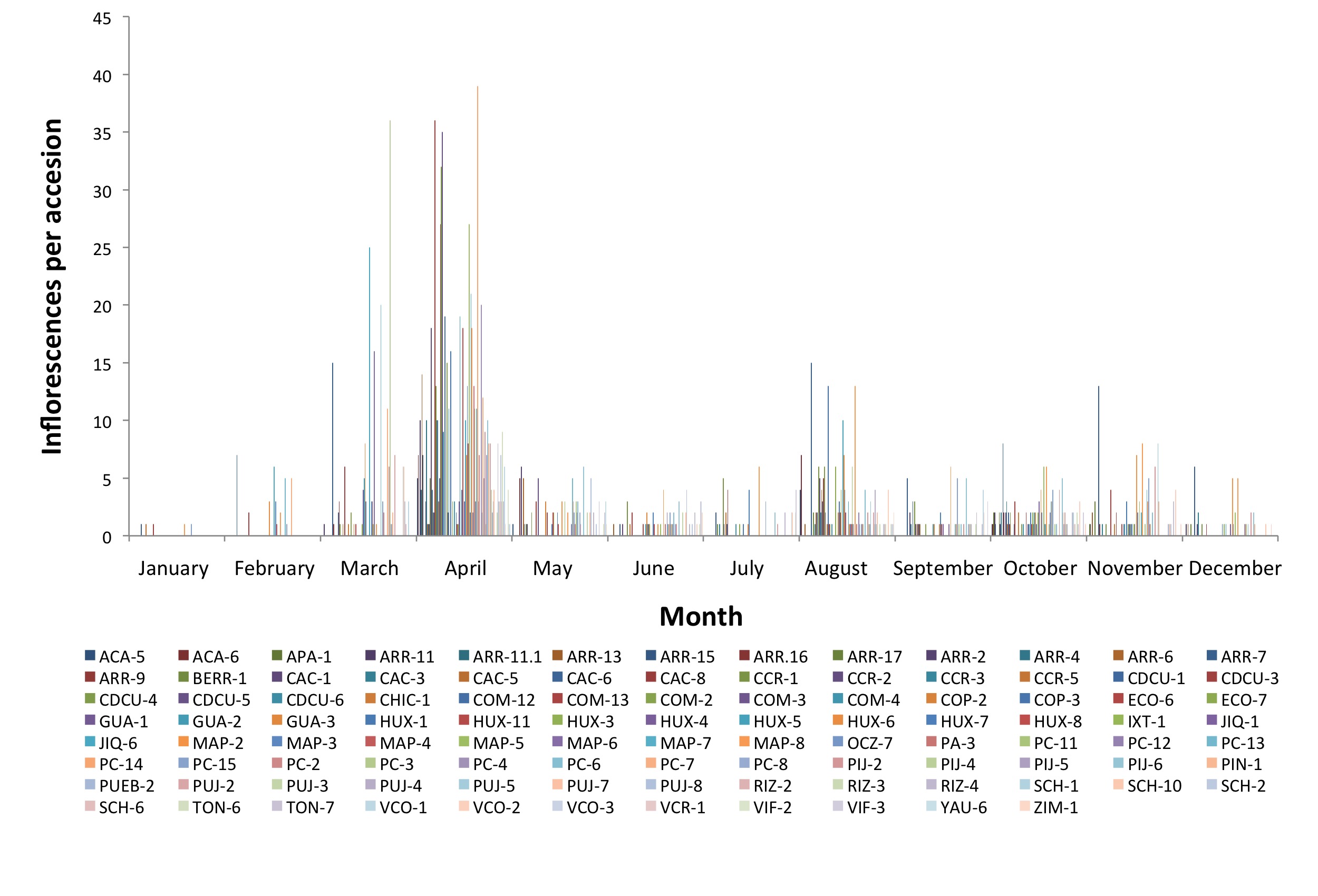
Flowering dynamics of 103 accessions of Jatropha curcas L. from the Jatropha Germplasm Bank of the Autonomous University of Chiapas, Mexico.
Flowering of Jatropha curcas in its center of origin
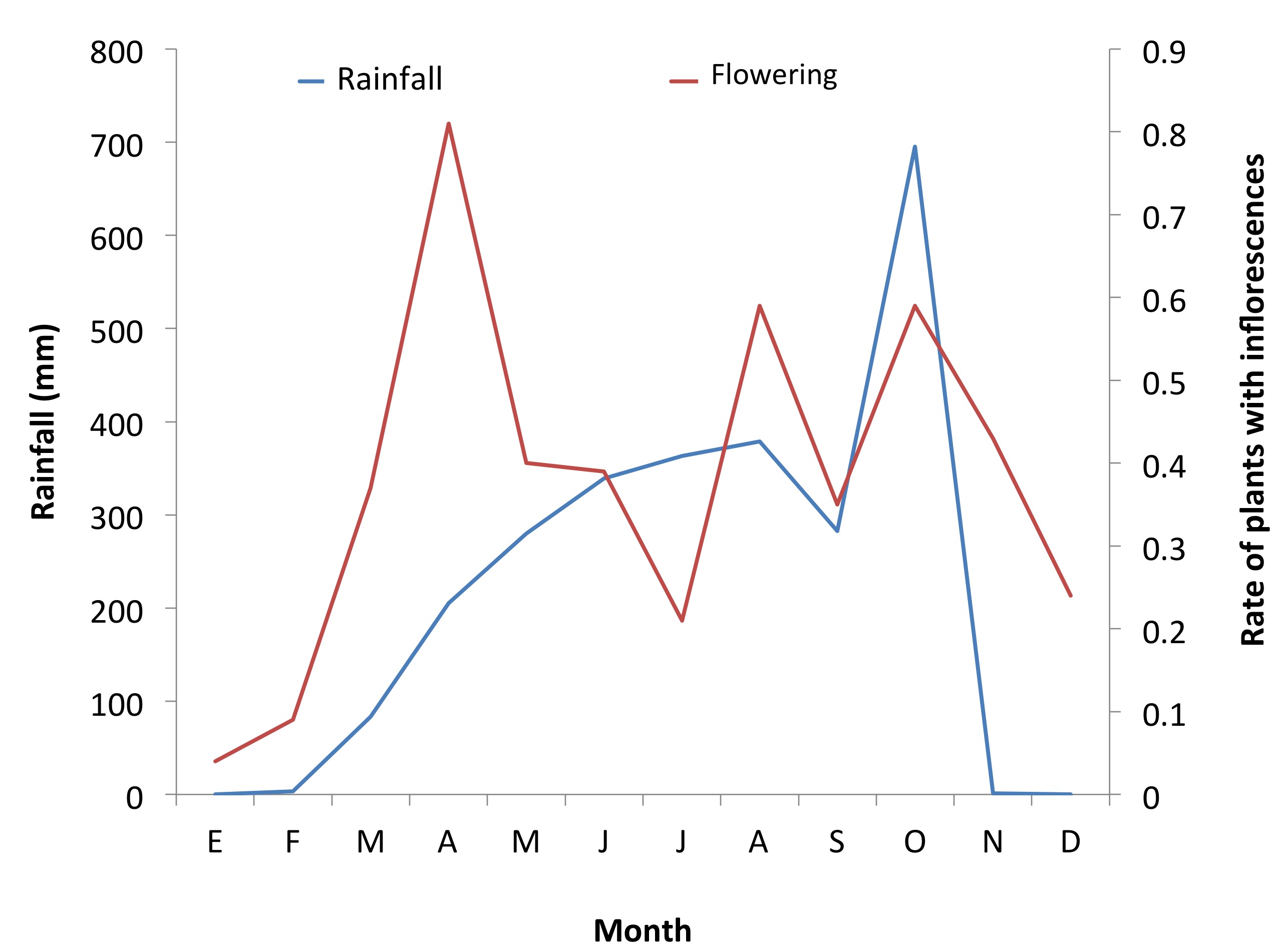
Relationship between the proportion of flowering accessions of Jatropha curcas L. from the Jatropha Germplasm Bank of the Autonomous University of Chiapas and rainfall in Tapachula, Chiapas, México.